







Why Some Websites Make People Comfortable Spending Money — And Yours Doesn't

Why Some Websites Make People Comfortable Spending Money — And Yours Doesn't
When I audited a client's website, I asked him one question: "Would you buy something from your own site?"
He thought for a moment and said: "I think… probably?"
That hesitation said everything.
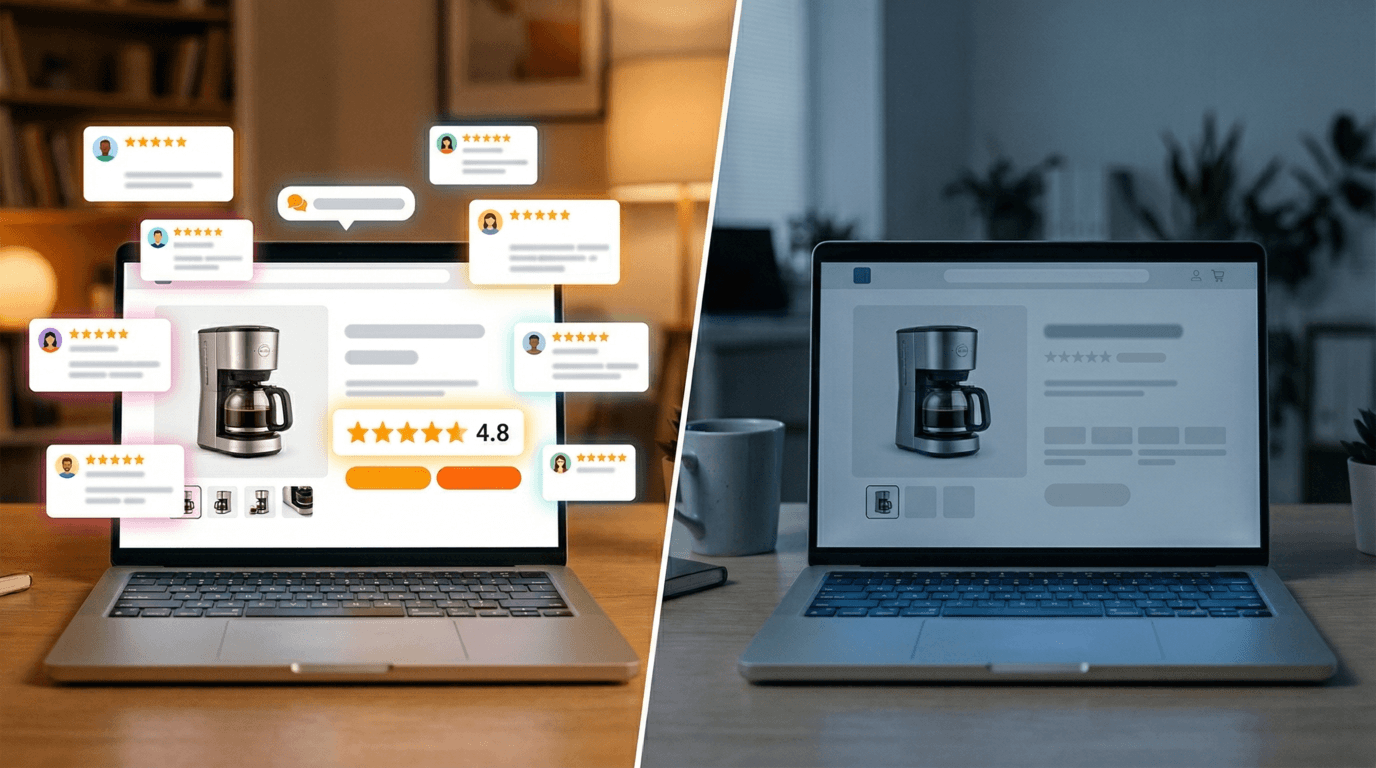
If the person who built the site isn't fully confident in it, a first-time visitor has zero chance of being convinced. I looked through his site carefully. Good product. Clean enough design. But one thing was almost completely absent: nobody was telling me this thing was worth buying. No reviews. No ratings. No real customer photos. No press mentions. No sign that anyone else had ever purchased from here before.
This is the social proof problem — and it's more fundamental than most technical CRO issues. It's harder to quantify, but it's often the single biggest drag on conversion rates.
Why Online Shoppers Need "Proof From Others"
When you shop in a physical store, your senses do the risk assessment for you. You can touch the product, try it on, feel the material, smell it. Your body helps you decide.
Online shopping strips all of that away. You're looking at photos and words. You have no way to verify whether what you're seeing is real — you just have to trust a website you've never visited before. And trusting a stranger on the internet carries real risk.
That's when people's natural risk-avoidance instinct kicks in: "Does this look like the photos? Will this site disappear? What's the return process like? Has anyone actually bought this before?"
Social proof is the most effective way to answer those questions. When a shopper sees "3,847 people have purchased this," or "4.8 stars across 1,200 reviews," or real customer photos showing the product actually matches the listing — their perceived risk drops, and their willingness to buy goes up.
BrightLocal research shows that 88% of consumers trust online reviews as much as personal recommendations from friends. A review from a complete stranger carries almost the same weight as a tip from someone you know.
Types of Social Proof, From Most to Least Powerful
Tier 1: Real Customer Reviews With Photos
This is the most powerful form of social proof in e-commerce. Written reviews are already persuasive — but reviews with real customer photos are twice as convincing, because images are harder to fake and easier to process instantly.
Platforms like Loox and Judge.me on Shopify can automatically send post-purchase emails encouraging customers to leave photo reviews, sometimes with a small discount as an incentive. Once this system is in place, your review count grows automatically with every sale.
Tier 2: Star Ratings and Total Review Count
"4.8 stars (1,247 reviews)" and "4.8 stars (3 reviews)" are not the same thing. The number of reviews signals "this many people have already bought this" — which is itself a form of social proof.
If your review count is still low, prioritize getting volume over chasing perfect scores. Fifty reviews at 4.5 stars is more convincing than five reviews at 5 stars.
Tier 3: Press Coverage and Influencer Endorsements
If your product has been featured in media, recommended by bloggers, or used by recognizable names, these are powerful trust signals. An "As Seen In" section with media logos builds credibility in seconds.
Even smaller creator endorsements count. What matters is that a third party — someone who isn't you — is saying the product is worth it.
Tier 4: Sales Numbers and Customer Counts
"10,000+ customers served" or "500 units sold this month" communicate that a lot of people have already made this decision — you're not taking a risk by being the first. This reduces hesitation significantly.
One rule: the numbers have to be real. Claiming "thousands of happy customers" when you've sold twelve units is a trust-killer if anyone notices. Small real numbers are always better than inflated fake ones.
Where You Place Social Proof Matters More Than What You Place
Most websites dump all their reviews at the bottom of the page. But social proof only works if it shows up at the moment a customer is hesitating — and by the time they scroll to the bottom, they've usually already left.
Based on how customers actually move through a purchase decision, social proof should appear in these specific places:
Just below the product title: Display your star rating and total review count next to the product name and price — right where a visitor's eyes land first. Make it clickable so they can jump to full reviews.
Near the Add to Cart button: Place one strong customer quote or a brief social signal ("868 sold") right next to your CTA. Give them one final push at the decision point.
On the checkout page: When someone is about to enter their credit card number, show a money-back guarantee and one strong review. Remove last-second doubt at the most critical moment.
Social proof isn't decoration. It's a conversion tool that needs to appear exactly when the customer needs to be convinced — not buried where it makes you feel better for having included it.
Back to the client who wasn't sure he'd buy from his own site: I added star ratings to his product pages, placed five photo reviews near his Add to Cart button, and added a customer count and press mention to his homepage. Two weeks later, conversion rate was up 1.4 percentage points. No ad changes. No product changes. Just giving visitors a reason to trust the site.
Does Your Website Give People a Reason to Buy?
Social proof is one of the most effective — and most overlooked — trust-building tools available. If your site is missing it, or if it's placed where no one will actually see it, that's worth fixing before anything else.
More...


Unleash Your Brand's